
Pyrolysis and solvolysis processes
Pyrolysis is used to thermally break down organic macromolecules into solid, liquid, and gaseous products. Rapid pyrolysis, in particular, optimizes the production of liquid bio-oils through careful adjustment of the reaction conditions. This allows biomass to be converted into a form that is energy-dense, economically transportable, and readily usable as a liquid in further processes (also referred to as a “biobased commodity”).
Rapid pyrolysis at KIT is carried out in a twin-screw mixing reactor. In this reactor, the shredded feedstock is mixed with a hot heat transfer fluid, causing it to be heated and thermally decomposed within a few seconds. The resulting pyrolysis products are separated from the heat transfer fluid and rapidly cooled. The heat transfer fluid is recirculated and reheated, allowing the pyrolysis plant to operate continuously. Solid products (coke and ash) are first separated from the product stream; subsequently, after a multi-stage condensation process, liquid products are obtained, which can be further processed in subsequent steps (see Conditioning of Pyrolysis Products).
.png)
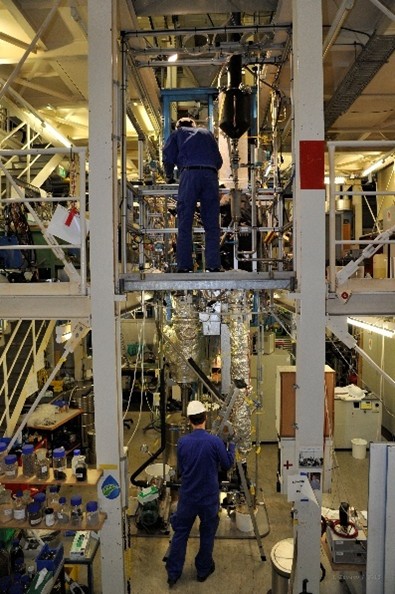
The working group’s primary focus is on expanding the range of potential feedstocks and on optimizing and further developing the fast pyrolysis process. In particular, the goal is to convert ash-rich biomass into usable pyrolysis products as efficiently as possible. To improve understanding of the process, laboratory experiments are combined with kinetic and thermodynamic models for process simulations.
Validation takes place in the institute’s process development plant (10 kg/h), where new plant components, operating modes, and measurement technology are also tested. The plant is part of the Carbon Cycle Lab at KIT.
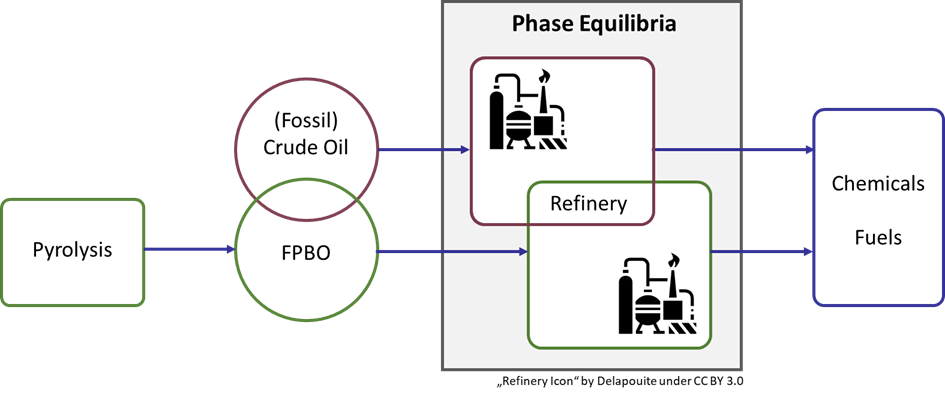
A key element of our ongoing work is the development of models to enable targeted product recovery. This is achieved through the condensation of hot pyrolysis gases and is a crucial step that determines the quality of the pyrolysis oil. To achieve this, phase equilibria must be reliably calculated, which is being investigated by this research group using a combined theoretical and experimental approach. The development of suitable models also enables the design of the necessary process steps for producing high-quality product fractions for specific applications. As a value chain, this is fundamentally comparable to the utilization of fossil crude oil in refineries, although the actual technical details of this value creation in the case of pyrolysis oil remain to be determined.