Catalyst Development Center (CDC)

From nanoparticles to industrial catalyst: The Catalyst Development Center (CDC) at KIT combines advanced and scalable material synthesis with theory and data-driven optimization for accelerating the path from lab-scale discovery to technical application by integrated research data management.
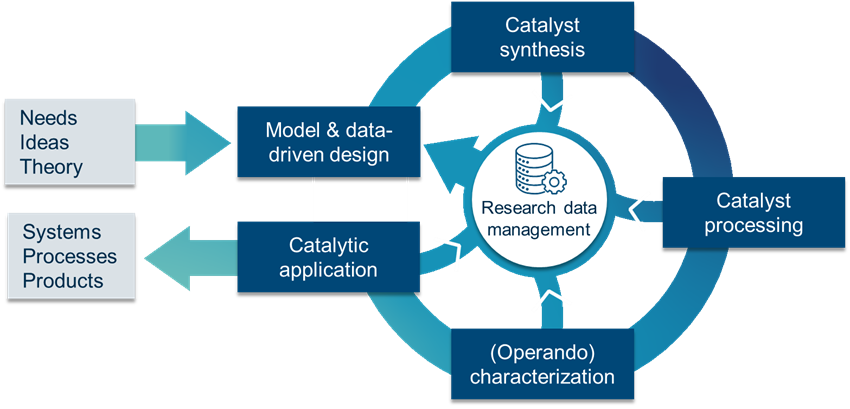
The Catalyst Development Center (CDC) is hosted by the Institute of Catalysis Research and Technology (IKFT) and represents a KIT wide Material Acceleration Platform (MAP) for the discovery, development and scale-up of catalyst materials by systematically capturing and exploiting theory as well as research data across the entire catalyst development chain — from synthesis to industrial application.
While material characterization and catalytic testing have long generated valuable data, the CDC closes a critical gap by also capturing data from catalyst synthesis and downstream processing steps such as calcination or activation as well as catalyst shaping. Combined with physical models from theoretical chemistry and machine learning approaches such as Bayesian optimization, this comprehensive dataset enables autonomous, model and data-driven optimization cycles that significantly reduce labor and material costs while shortening the time to technical demonstration and application for advanced catalyst technologies.
Catalyst Preparation: From Conventional to Advanced Techniques
A core strength of the CDC lies in its broad portfolio of catalyst synthesis methods, spanning both established and cutting-edge techniques as well as multiple scales enabling the preparation of nanoparticulate materials, powder catalyst and shaped catalyst bodies up to the kilogram scale.
- Impregnation: conventional, robust routes for depositing active components onto support materials
- Co-precipitation: well-controlled multi-component catalyst systems
- Flame spray pyrolysis (FSP): a versatile gas-phase technique for producing highly defined catalyst materials
- Colloidal synthesis of clusters and nanoparticles: highly controllable and tunable synthesis of noble metal-based colloidal nanoparticles
- Surfactant-free nanoparticle synthesis: metal oxide, hydroxide, and oxyhydroxide nanoparticles (e.g., Ce, Co, Cu, Fe, In, Ni)
This portfolio enables production of technical catalyst and nanoparticles, which may be used as model systems for fundamental structure-activity studies and as building blocks for application-relevant catalysts.
Scale-Up of Catalyst Preparation
The CDC places particular emphasis on bridging the gap between gram-scale research catalysts and the larger quantities required for real-world deployment.
- Scale-up of conventional catalyst preparation (co-precipitation, impregnation, nanoparticle synthesis): synthesis strategies are systematically scaled from laboratory to kilogram quantities
- Continuous catalyst preparation techniques (co-precipitation, flame spray pyrolysis, nanoparticle synthesis): transferring (semi) batch syntheses to continuous operation modes enables production of sufficient material for in-house research activities, demonstration units and external partners
- Catalyst shaping (agglomeration, extrusion, tableting): powder catalysts are converted into shaped bodies, which enables dedicated studies on how shaping affects the physico-chemical and catalytic performance of the final product and for an accelerated transfer to technical applications
Structure and Approach
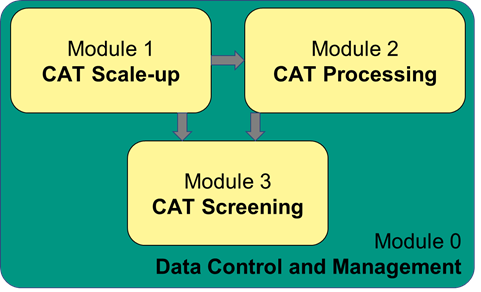
The CDC is built around three interconnected technical modules: CAT Scale-Up, CAT Processing, and CAT Screening. These are unified by an integrated Data Control and Management module. Research groups from both university and large-scale research area contribute to and benefit from this shared infrastructure. By standardizing research and process data management, the CDC breaks down barriers between the different stages and disciplines of catalyst development. Here multiple tools from NFDI (national research data management infrastructure) initiatives, such as NFDI4Cat, are implemented and harvested to drive data-based discovery and optimization as well as documentation and archiving of all (meta)data.
The CDC drives the establishment of a digital framework for catalyst preparation in close collaboration with the catalysis community. The fully digitalized infrastructure enables aggregation of data for scalable catalyst syntheses bridging academic and industrial needs for a facilitated transfer of catalyst preparation to industrial environment.